Artificial Intelligence is changing how software is built.
Most conversations focus on code generation, automation, and productivity gains. What often gets overlooked is the role that people still play in designing, governing, and validating solutions.
Recently, our team at Acclario IT decided to put emerging AI-assisted development capabilities to the test through an unlikely use case: a World Cup 2026 office sweep.
What began as a simple idea quickly became a valuable exercise in understanding where AI adds value, where human expertise remains essential, and what organisations should consider as these technologies become more mainstream.
Starting with a Simple Problem
The original objective was straightforward: We wanted a better way to manage a World Cup sweep than spreadsheets, email chains, and manual score tracking.
The initial requirements were modest:
- Randomly allocate teams to participants
- Track match results
- Display a leaderboard
Using Microsoft’s Vibe Coding (Preview), we began experimenting with AI-assisted application development to understand how rapidly ideas could move from concept to working software.
What happened next was interesting.
From Team Draw to Tournament Platform
As the application evolved, new ideas emerged almost as quickly as they could be implemented.
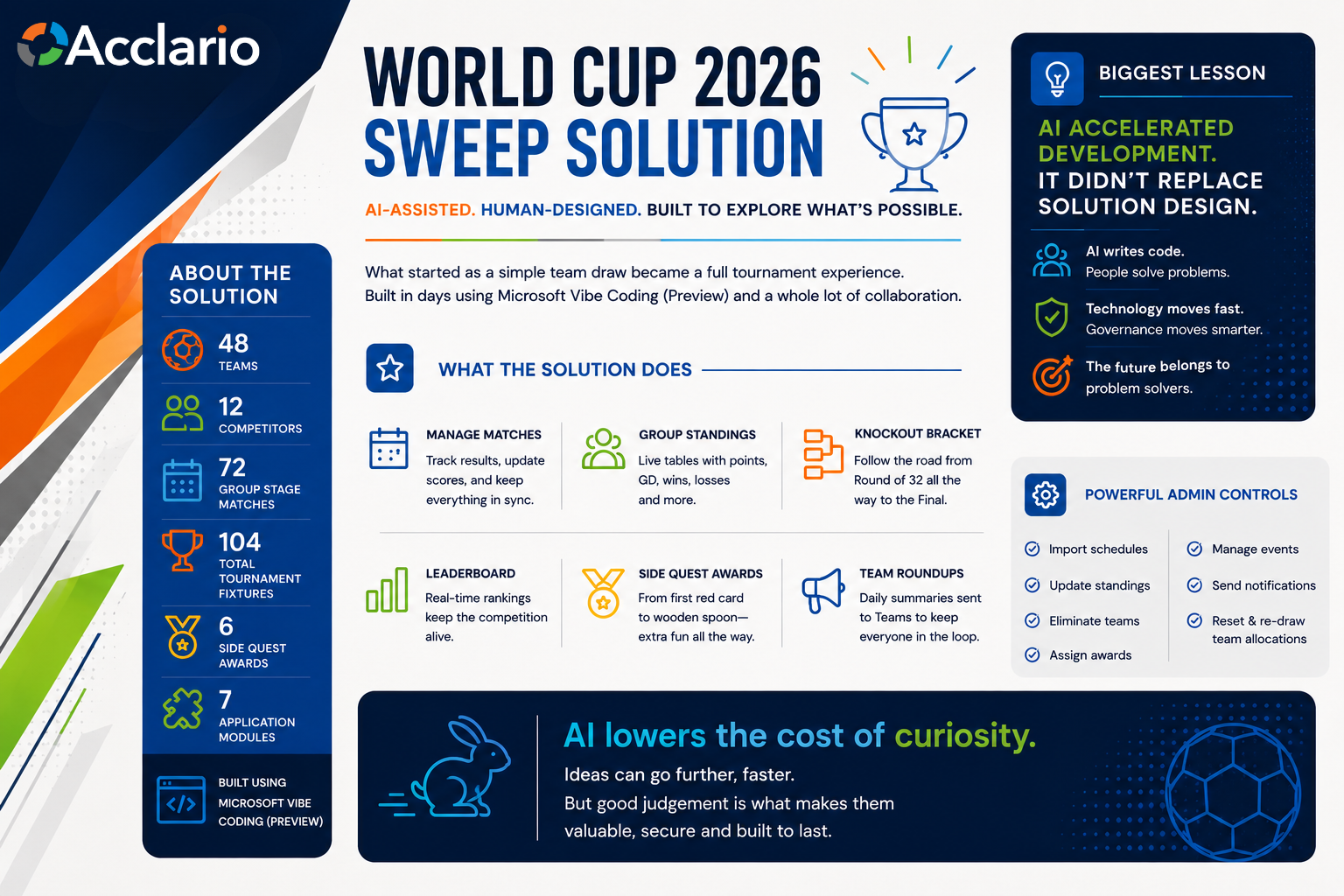
The solution expanded to include:
- Automated team allocation
- Match scheduling and result tracking
- Group stage standings
- Knockout bracket progression
- Competitor leaderboards
- Side quest awards and achievements
- Automated Teams communication summaries
- Tournament administration and governance controls
Before long, what started as a social club activity had become a complete web application supporting an entire tournament lifecycle.
The speed at which features could be designed, tested, refined, and implemented was significantly faster than traditional development approaches.
That was the first lesson.
AI can dramatically accelerate delivery.
But it was not the most important lesson.
The Feature Nobody Planned
One of the more interesting observations was how quickly ideas became working features.
As the tournament evolved, new concepts were introduced simply because they sounded fun.
Side quest awards such as –
- First Red Card
- First Own Goal
- The Collector
- The Reaper
- Fair Play Award
- Wooden Spoon
– went from casual conversations to implemented functionality in a matter of hours.
Traditionally, ideas like these might have been captured as future enhancements or left on a whiteboard. AI-assisted development significantly reduced the effort required to move from “Wouldn’t it be nice if…” to a working feature.
This ability to experiment rapidly may prove to be one of the most valuable outcomes of AI-assisted development.
The Hard Part Was Never the Code
One of the biggest misconceptions about AI-assisted development is that generating code is the most difficult part of software delivery.
In reality, code is only one component of a successful solution. Even with AI generating significant portions of the application, the team still needed to determine:
- How information should be structured
- What business rules should apply
- How users would interact with the system
- What administrative controls were required
- How data should flow between features
- How outcomes would be validated and tested
The application only worked because people were continuously making design, architecture, governance, and user experience decisions.
AI accelerated implementation; It did not replace solution design.
What We Learned About AI-Assisted Development
The experiment reinforced several observations that are becoming increasingly relevant for organisations exploring AI-enabled delivery.
AI Accelerates the First 80%
Creating a working application structure can happen remarkably quickly.
User interfaces, navigation, basic functionality, and standard components can often be generated in a fraction of the time required through traditional methods.
This makes AI particularly effective for:
- Prototyping
- Proof of concepts
- Internal applications
- Solution discovery
- Early-stage design validation
Human Expertise Becomes More Important, Not Less
As development becomes faster, the quality of decisions becomes increasingly important.
- Poor architecture can now be implemented more quickly.
- Poor security can be introduced more quickly.
- Poor assumptions can be embedded more quickly.
The role of experienced consultants, architects, business analysts, and solution designers becomes even more valuable because they provide the context and judgement that AI cannot reliably deliver on its own.
The better the tool gets, the more valuable good judgement becomes.
Governance Must Keep Pace
AI-assisted development introduces new considerations around:
- Security
- Data privacy
- Solution ownership
- Technical debt
- Validation and testing
- Documentation and traceability
These considerations become particularly important as organisations move from experimentation into production environments.
The question is no longer whether AI can build an application; The question is whether the application has been built safely, securely, and appropriately for its intended purpose.
Innovation in Practice
This application was developed as an internal innovation exercise to explore AI-assisted software development in a low-risk environment.
While intentionally built for a social club activity, the lessons learned around architecture, governance, user experience, security, and AI oversight are directly applicable to enterprise solution delivery.
Experimentation in low-risk environments creates valuable knowledge that can later be applied in client-facing scenarios with appropriate governance, architecture, and delivery disciplines.
Looking Beyond the Technology
While this project was intentionally lightweight and fun, it reflects a broader shift taking place across the technology industry.
At Acclario IT, we are actively exploring a range of emerging AI capabilities, including:
- AI-assisted application development
- Autonomous agents
- AI-enhanced web development
- Intelligent automation
- Modern Microsoft AI tooling
The objective is not simply to adopt new technology; It is to understand how these capabilities can be applied responsibly to solve real business problems.
The Future Belongs to Problem Solvers
Perhaps the most significant takeaway from this project is that AI is changing the nature of software development rather than eliminating the need for skilled practitioners.
The organisations that will benefit most from AI are unlikely to be those that simply generate the most code, they will be the organisations that combine emerging technology with strong foundations in:
- Business analysis
- Solution architecture
- Security
- Governance
- User experience
- Delivery management
AI lowers the cost of curiosity.
It allows ideas to be explored, tested, and refined more quickly than ever before.
But curiosity alone is not enough – good judgement remains essential.
In fact, as the tools become more capable, it may become the most important skill of all.
Learn more about how Acclario can help here.